ShopDreamUp AI ArtDreamUp
Deviation Actions



Suggested Deviants


Suggested Collections


You Might Like…


Featured in Groups


Description
© Ben Heine || Facebook || Twitter || www.benheine.com
___________________________________________________
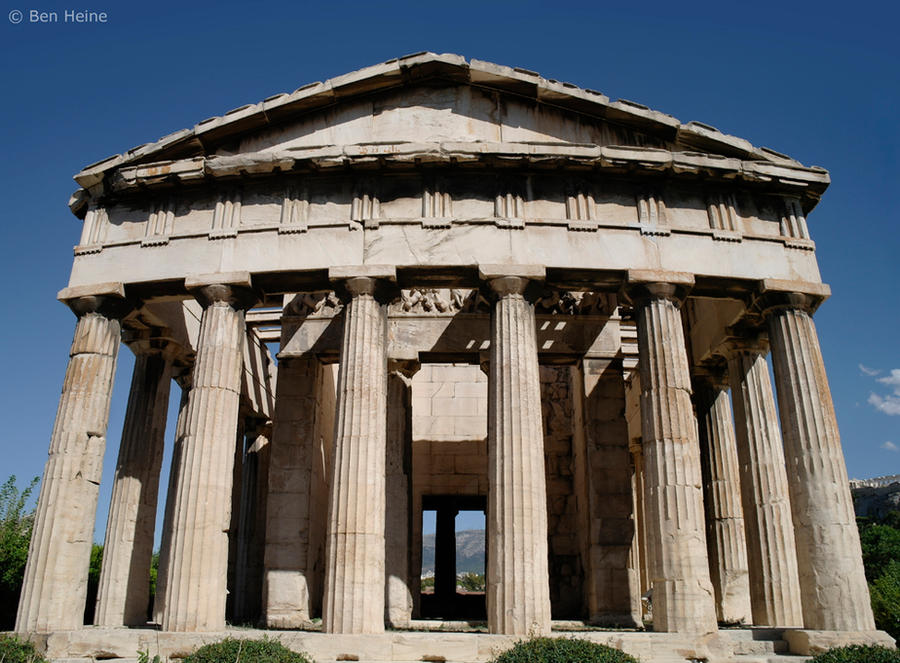
I visited the Ancient Greek Agora a few days ago. Terrific place, a must see.
The above photo has been shot with the Samsung NX10, provided by Samsung Electronics Co., Ltd.
____________________________________________________
For more information about my artwork: info@benheine.com
____________________________________________________
More facts: The Temple of Hephaestus and Athena Ergane, also known as the Hephaisteion or Theseion, is the best preserved ancient Greek temple. It is a Doric order peripteral temple, located at the north-west side of the Agora of Athens, on top of the Agoraios Kolonos hill. From the 7th century until 1834, it served as the Greek Orthodox church of St. George Akamates.
Hephaestus was the patron-god of metal working. Athena Ergane was the patron-goddess of pottery and crafts in general. There were numerous potter shops and metal working factories in the vicinity of the temple, justifying the dedication of the temple to these two deities. The archaeological evidence suggests that there was no previous building located on top of the hill, except for a small sanctuary which was burned when the Persians occupied Athens in 480 BC. The name Theseion or Temple of Theseus, was erroneously attributed to the monument under the assumption it housed the remains of the Athenian hero Theseus, brought back to the city from the island of Skyros by Kimon in 475 BC.
After the battle of Plataea, the Greeks swore never to rebuild their sanctuaries, destroyed by the Persians during their invasion of Greece, but to leave them in ruins, as a perpetual reminder of barbarian ferocity. The Athenians directed their funds towards rebuilding their economy and strengthening their influence in the Delian League. When Pericles came to power, he envisioned a grand plan for transforming Athens into the centre of Greek power and culture. The temple of Hephaestus in the Agora was meant to embody the richest evidence of Athenian tradition, conservatively in the Doric order and the full complement of carved metopes that had long been Athens’ pride on its conspicuous Treasury at Delphi. Construction started in 449 BC, but the temple was not completed until 415 BC, presumably because emphasis shifted towards the monumental construction on the Acropolis, with funds and workers being redirected towards the Parthenon. The western frieze was completed between 445-440 BC, while the eastern frieze, the western pediment and several changes in the building's interior are dated to 435-430 BC. It was only during the Peace of Nicias (421-415 BC) that the roof was completed and the cult images were installed. The temple was officially inaugurated in 416-415 BC. (Article's source: Wikipedia)
___________________________________________________
I visited the Ancient Greek Agora a few days ago. Terrific place, a must see.
The above photo has been shot with the Samsung NX10, provided by Samsung Electronics Co., Ltd.
____________________________________________________
For more information about my artwork: info@benheine.com
____________________________________________________
More facts: The Temple of Hephaestus and Athena Ergane, also known as the Hephaisteion or Theseion, is the best preserved ancient Greek temple. It is a Doric order peripteral temple, located at the north-west side of the Agora of Athens, on top of the Agoraios Kolonos hill. From the 7th century until 1834, it served as the Greek Orthodox church of St. George Akamates.
Hephaestus was the patron-god of metal working. Athena Ergane was the patron-goddess of pottery and crafts in general. There were numerous potter shops and metal working factories in the vicinity of the temple, justifying the dedication of the temple to these two deities. The archaeological evidence suggests that there was no previous building located on top of the hill, except for a small sanctuary which was burned when the Persians occupied Athens in 480 BC. The name Theseion or Temple of Theseus, was erroneously attributed to the monument under the assumption it housed the remains of the Athenian hero Theseus, brought back to the city from the island of Skyros by Kimon in 475 BC.
After the battle of Plataea, the Greeks swore never to rebuild their sanctuaries, destroyed by the Persians during their invasion of Greece, but to leave them in ruins, as a perpetual reminder of barbarian ferocity. The Athenians directed their funds towards rebuilding their economy and strengthening their influence in the Delian League. When Pericles came to power, he envisioned a grand plan for transforming Athens into the centre of Greek power and culture. The temple of Hephaestus in the Agora was meant to embody the richest evidence of Athenian tradition, conservatively in the Doric order and the full complement of carved metopes that had long been Athens’ pride on its conspicuous Treasury at Delphi. Construction started in 449 BC, but the temple was not completed until 415 BC, presumably because emphasis shifted towards the monumental construction on the Acropolis, with funds and workers being redirected towards the Parthenon. The western frieze was completed between 445-440 BC, while the eastern frieze, the western pediment and several changes in the building's interior are dated to 435-430 BC. It was only during the Peace of Nicias (421-415 BC) that the roof was completed and the cult images were installed. The temple was officially inaugurated in 416-415 BC. (Article's source: Wikipedia)
Image size
1000x736px 548.63 KB
Make
SAMSUNG
Model
NX10
Shutter Speed
1/180 second
Aperture
F/10.0
Focal Length
18 mm
ISO Speed
100
Date Taken
Sep 1, 2010, 3:10:17 PM
© 2010 - 2024 BenHeine
Comments10
Join the community to add your comment. Already a deviant? Log In

Beautiful work! 